
Our MCI line of jib cranes are designed and installed to exacting specifications, easily meeting all of the current design and engineering regulations for quality, reliability and safety. Munck Cranes in Ontario, has a variety of solutions for all your material handling needs, from large capacity overhead bridge cranes, gantry and semi-gantry cranes to a full line of safe, reliable, high capacity jib cranes and extensions.

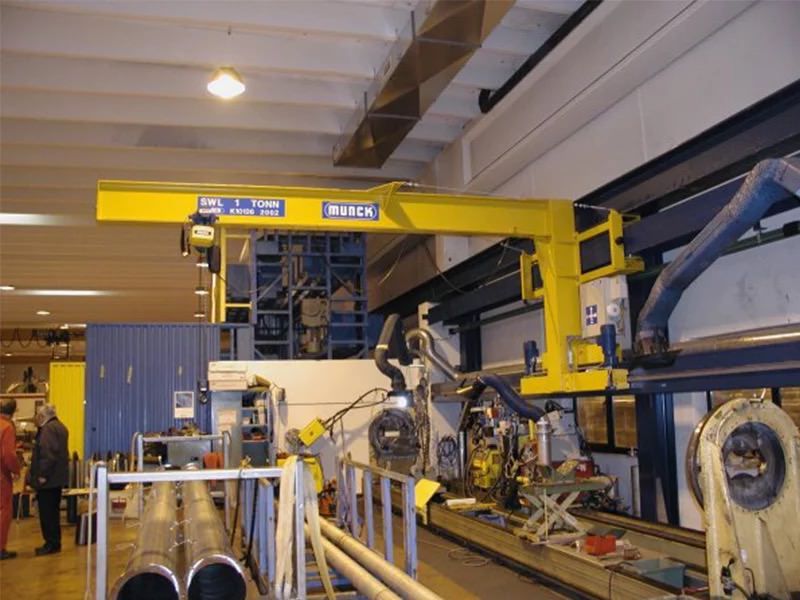
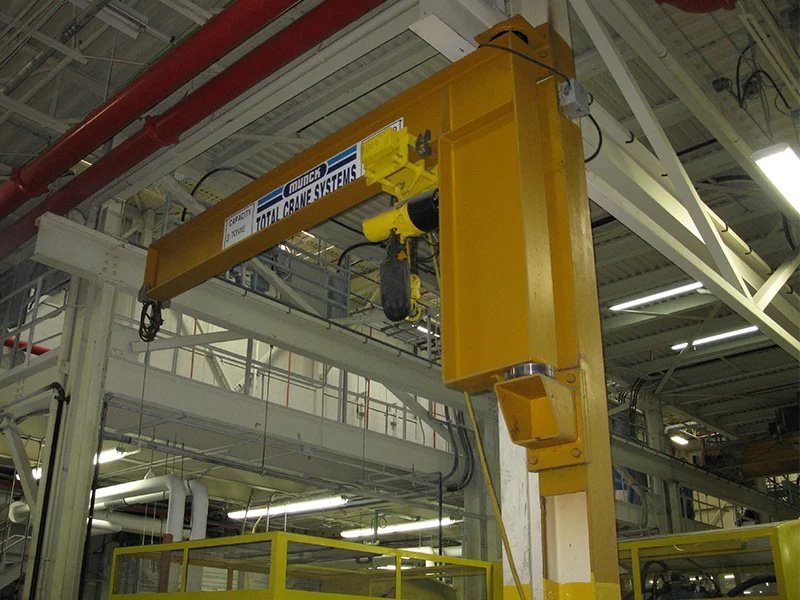
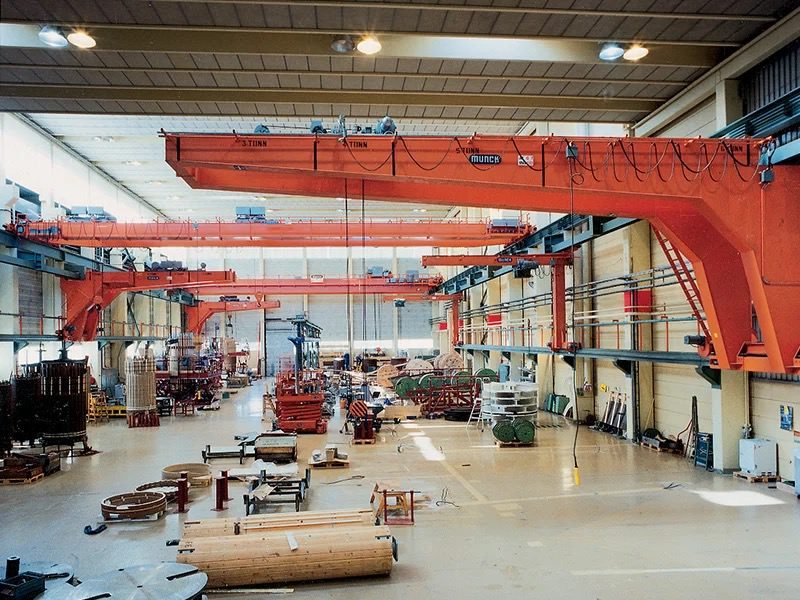
Jib cranes operate by pivoting a horizontal arm (the jib) around a central mounting point, allowing for precise material handling within a defined circular or semi-circular area. Also known as folding jib cranes, they are ideal for both light and heavy duty applications in confined spaces, and give operators the ability to manage a wide variety of materials depending on how the jib is mounted.
In practice, a jib crane lifts and moves materials efficiently within its designated swing radius.
Wall or column mounted jib cranes are an elegant, cost-effective and reliable material handling solution without a requirement to add additional columns or footings during install. The Munck Cranes team is eager to assist you in selecting or customizing the ideal jib crane solution to align with your application and building requirements.

Enhances operational control and safety by allowing precise movement adjustments. This mechanism helps prevent overload and wear during daily use.
Facilitates smooth and consistent rotational movements, improving crane efficiency and load handling. These bearings reduce friction and extend mechanical lifespan.
Provides maintenance access, ensuring the crane remains in optimal working condition. Quick inspections can minimize downtime and spot wear early.
Delivers smooth and accurate rotation, critical for precise positioning of loads. High-precision machining reduces vibration and noise during operation.
Ensures structural integrity and stability, crucial for handling heavy loads. It resists twisting under stress, maintaining vertical alignment.
Enhances the crane's durability and load-bearing capacity. They distribute stress across wider areas for long-term structural support.
Allows for efficient use of space and easier installation in various environments. This design is ideal for tight spaces or retrofit scenarios.
Simplifies the installation process, reducing setup time and potential errors. Pre-planned installation ensures better safety and alignment.
Offers flexibility in crane configuration and maintenance. This feature allows technicians to access internal components with ease.
Provides customizable limits to crane movement, enhancing safety and preventing over-travel. You can adjust them to meet site-specific constraints.
Offers versatile options for load handling, adaptable to different weights and environments. Each hoist type suits specific height or duty requirements.
Improves stability and reduces strain on the crane structure during operation. It eliminates unwanted twisting that can compromise safety.
Guarantees precise and consistent crane movements, essential for handling delicate operations. It plays a key role in repeatable positioning accuracy.
Enhances safety by providing an easy method to cease crane operations immediately when necessary. Prevents unauthorized or accidental activation.
Supplies continuous power to the crane, essential for consistent operation. A reliable feed avoids performance interruptions during use.
Optimizes load distribution, crucial for maintaining stability and preventing structural failures. Proper foundation design ensures safe, long-term operation.
Jib cranes come in several types, each designed for specific application needs and workspace configurations.
Here are the most common types of jib cranes:
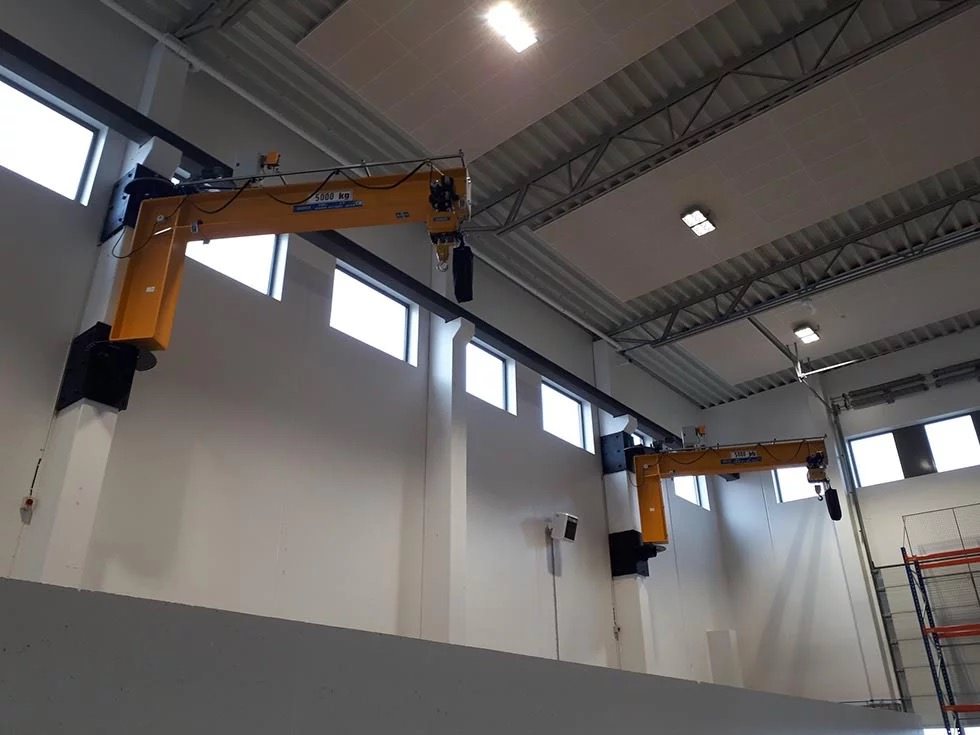
These cranes are attached to a wall or vertical structure and do not require a floor base. They offer a 180-degree rotation and are ideal where space is limited. Benefits include exceptional boom clearance and they can be collapsed to avoid interference for other overhead cranes and equipment in your facility.
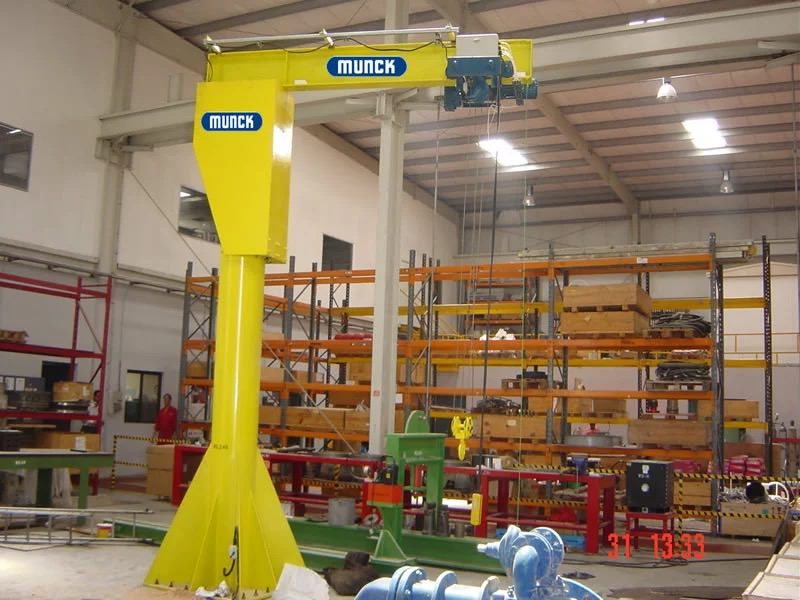
Mounted directly to the floor, these cranes don't rely on building support. They allow 360-degree rotation, making them versatile across industries.

Floor-supported and top-stabilized, these cranes offer 360-degree rotation without a foundation. They provide higher capacity and reach.
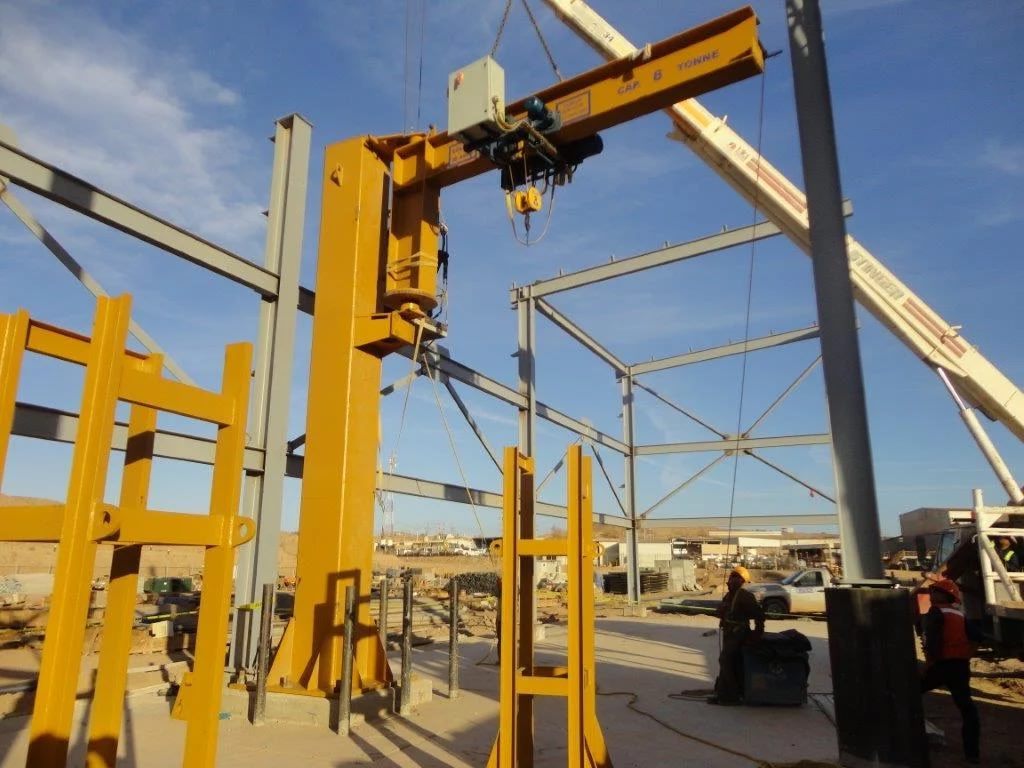
Featuring two independently moving arms, these cranes offer excellent maneuverability in tight spaces and around obstructions.
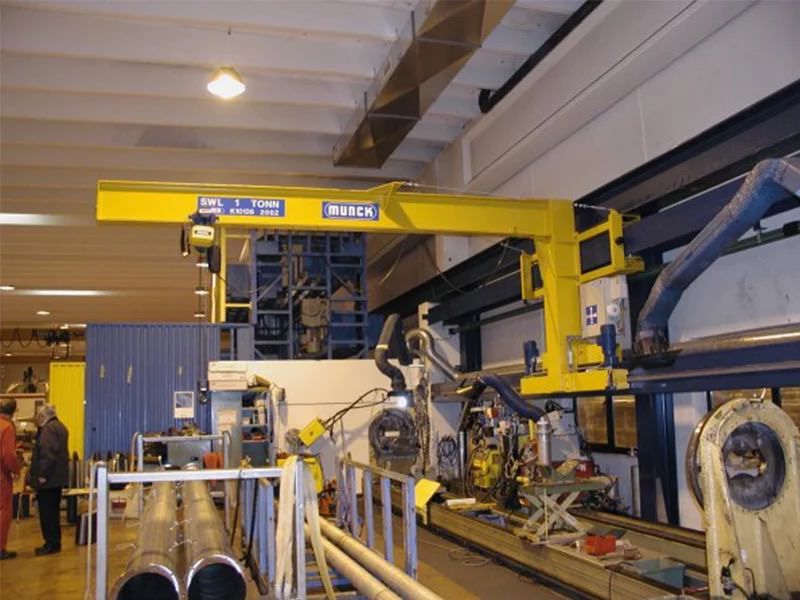
Mounted on wall rails, this crane type travels laterally along long walls, ideal for extended workspaces with linear lifting paths.
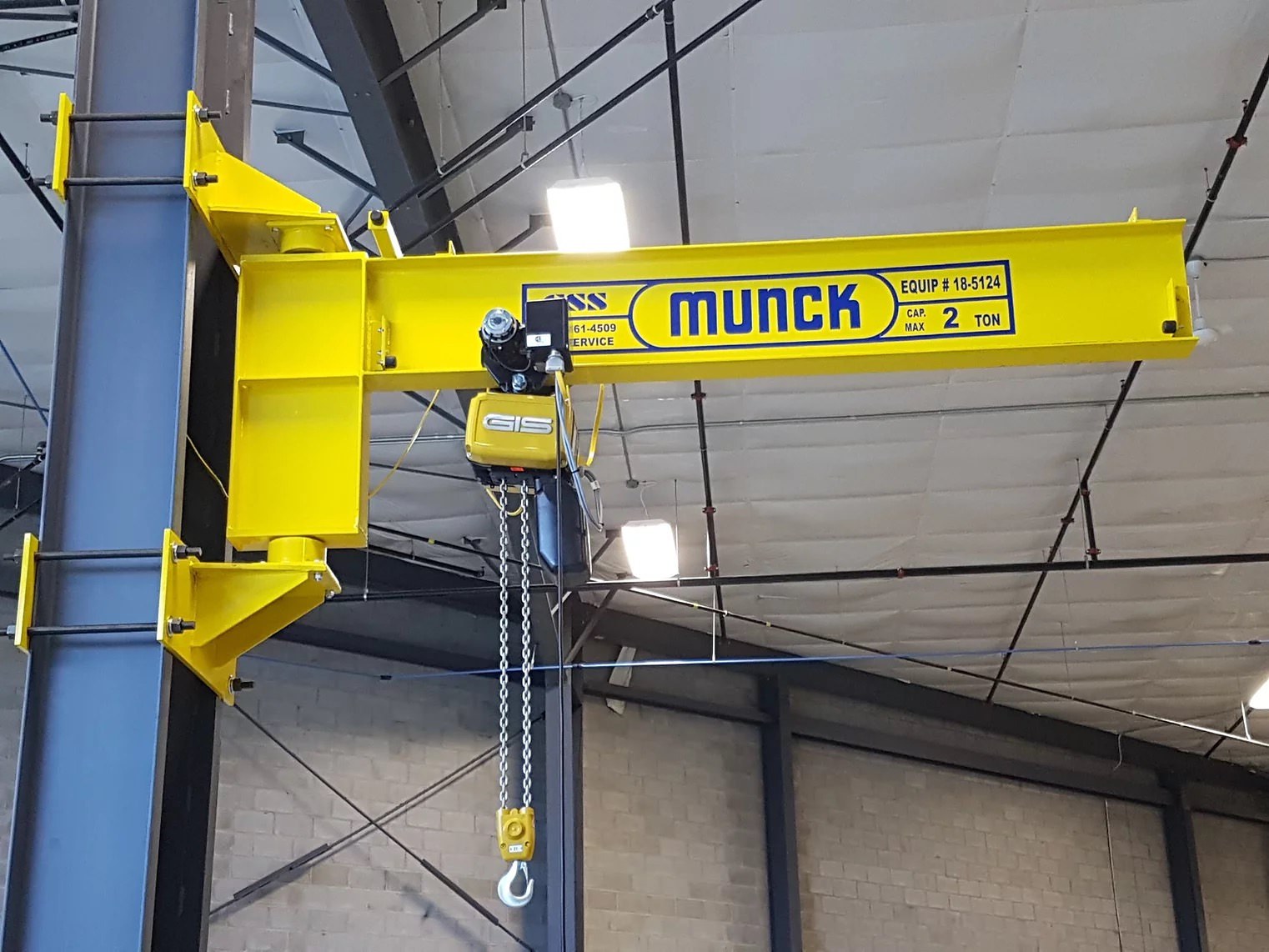
A cantilever jib crane is a hoisting crane with a swing or fixed cantilever (a long projecting beam or girder fixed at only on end, along which a hoisting trolley moves). Cantilever cranes are used primarily in shops of industrial enterprises and in closed warehouses. Load capacity of cantilever cranes ranges from 4 Tons to 10 Tons.

Workstation Jib Crane
I-Beam Jib Crane
Wall Walking Jib Cranes
Double Girder Overhead Jib Crane
Single Girder Overhead Jib Crane
Automotive Crane
Engine Crane
Telescopic Boom Crane
Maintenance Crane
Industrial Cranes
Loading Dock Crane
Machine Shop Workstation Crane
Assembly Line Support Crane
Before You Invest in Material Handling and Heavy Lifting Equipment, Talk to Munck Cranes!